
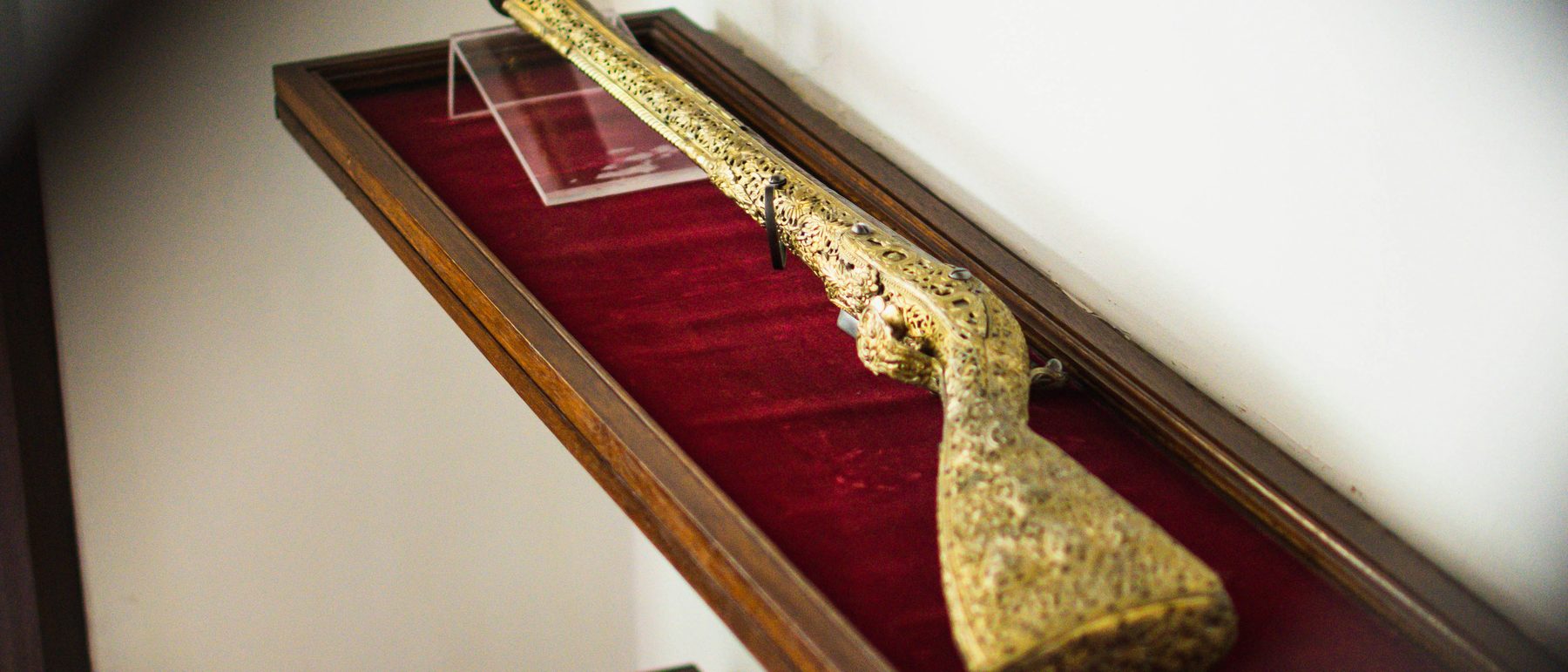
Firearms & Gun Collections Appraisals
Single pieces, inherited collections, and full safes — valued for estate, donation, insurance, and division.
Three steps. Done remotely, no home visit.
- Send photos and a short descriptionPhone pictures are fine. What should I send?
- Get a fixed written quoteUsually the same day. Nothing owed until you agree.
- Receive a signed reportPersonal property usually within 48 hours, written to IRS and court standards.
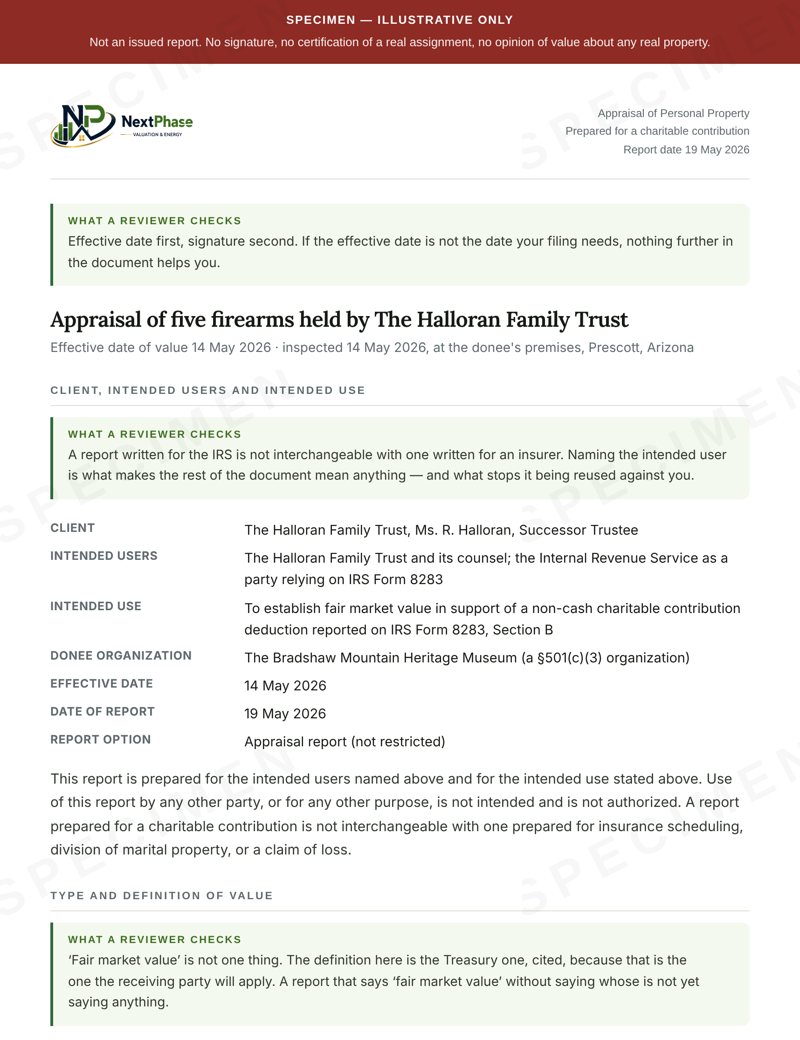 See exactly what you’ll receive →
Done remotely, anywhere in the U.S. No home visit.
What we appraise
- Modern sporting rifles and shotguns
- Curio & relic and military surplus
- Antique and black powder
- Commemorative and limited editions
- Handguns and revolvers
- Full safe contents
What to send
- Photographs of each firearm: full length both sides, receiver, and any markings
- Manufacturer, model, and serial number where legible
- Barrel length and calibre / gauge
- Original box, papers, or provenance if held
- Any documented modifications or refinishing
Firearms are appraised as personal property. NextPhase does not buy, sell, transfer, or broker firearms, and does not take possession — assignments are documentary.
Fees
| Scope | Typical fee |
|---|---|
| 1 item or lot | $75 – $150 |
| 2–10 items | $125 – $400 |
| 11+ items, collections or full contents | quoted per engagement |
How firearms and gun collections appraisals work: the details
What drives the number
Firearms are one of the most commonly mis-valued asset classes in an estate. Condition grading, originality, matching numbers, and provenance can swing value by an order of magnitude, and a blue-book number does not survive scrutiny at the IRS or in court.
What actually moves the number
Every asset class has its own small number of factors that do most of the work. For firearms & gun collections they are these, and they are the reason a general-purpose valuation and a considered one can be so far apart.
Originality, before anything else
A refinished receiver, a replaced stock, or a re-blued barrel can move a collectible firearm’s value by more than its entire condition grade would. The work is often good enough that the owner does not know it was done — it was frequently done decades ago by a previous owner, with the honest intention of tidying the gun up. This gets examined before condition, because condition is meaningless once originality is in question.
Matching numbers, and which numbers matter
On military arms in particular, serial numbers appear on more than the receiver — bolt, barrel, floorplate, sometimes the stock. Whether they match is not a detail; for some models it is the largest single factor in the number. Which parts are supposed to be numbered varies by maker, model and production period, and getting that wrong in either direction is the most common technical error in amateur firearms valuation.
Configuration within a model
Two rifles of the same model and year can occupy very different markets on barrel length, sight configuration, chambering, or a factory option. "Winchester Model 1894" is not an identification; it is a family. The report identifies the exact configuration and says what evidence supports that identification.
Provenance, when it is documentable
Documented history contributes only when it can be evidenced — a factory letter, a period photograph, a bill of sale, unit records. A family story is recorded as a family story and is not valued. That distinction matters most in exactly the cases where the story is most compelling.
Who reads the finished report
For a charitable donation over $5,000 the report goes to the IRS behind a Form 8283, and it is tested against the qualified-appraisal requirements — appraiser qualifications, effective date within the required window, the specific description, and the method used. For an estate it goes to the executor and the probate court, and to the IRS if a return is filed. For insurance it goes to an underwriter who cares about replacement in the relevant market and about itemisation. For a division of property it goes to both sides and to their counsel, and its job is to be difficult to attack from either direction.
How the fee gets set
Firearms price on identification difficulty, not headcount. Twenty post-war production guns of common models is a shorter assignment than three arms that need factory-letter research and configuration verification. A safe of ordinary hunting rifles is quick. One martial revolver with a questionable refinish is not.
What arrived
Photographs of a lever-action rifle, both sides full length, plus the receiver markings and the barrel address. The owner reported it as "a Winchester, family says around 1900."
What identification established
The barrel address and the receiver markings placed it as a specific configuration — octagon barrel, crescent buttplate, a chambering that narrows the production window. The family’s date was close but the configuration, not the date, is what selects the comparable market.
What condition established
Original finish thinning to gray at the muzzle and carrier — wear, not refinishing. Bore bright. No evidence of re-bluing at the screw heads or lettering, which is where refinish usually shows first.
What the evidence was
Completed auction results within eleven months, restricted to the same configuration in comparable original finish. Asking prices were read for context and not used as evidence.
What the report said
A conclusion, the comparables it rests on, and a statement that the family’s attribution of date was not relied upon because configuration already established the production window independently.
Three things that cost people money
All three are done with good intentions, usually by someone trying to help. They are worth knowing whoever you end up hiring.
- Cleaning it first
The single most expensive thing an owner can do before an appraisal is make the gun look better. Steel wool on a patina, oil on a stock, a polish on the brass — all irreversible, all detectable, all deductions. Photograph it as it sits.
- Valuing from a blue book
Published guides are averaged retail asking figures for a generic example in a stated grade. They are a starting point for a dealer and they are not evidence of fair market value for the IRS or a court, because they are not completed transactions for the specific item.
- Treating the safe as one item
A collection is valued as its constituent lots unless it was assembled and would be marketed as a set. Reporting "a gun safe and contents" to an insurer generally means an itemisation is required later, usually after a loss, which is the worst possible time to do it.
Related personal property assets
Questions about firearms & gun collections
Do you take possession of the firearms?
No. NextPhase does not buy, sell, transfer, broker, or take possession of firearms. Assignments are documentary — photographs and information for a desk appraisal, or an on-site examination where the firearms stay where they are.
Can you appraise NFA items?
The valuation of an NFA-registered item is documentary work and is within scope. Anything to do with transfer, registration status, or lawful possession is a legal question for your attorney and the ATF, and no opinion on it is expressed in the report.
The serial number is worn off. Is it still appraisable?
Usually yes. It is reported as illegible rather than guessed, and identification then rests on the markings and configuration that are readable. That limitation is stated in the report rather than hidden, which is what makes the rest of it credible.
My father said one of these belonged to someone notable.
It is recorded as a reported history and valued without a provenance premium unless it can be evidenced. If you want the story chased, say so at the quote stage — factory letters and archive requests take weeks and sometimes come back empty, and that has to be priced in advance.
 A parent died. Do you need an appraisal of their belongings?
 Retrospective and date-of-death valuations
Ready for a number you can defend?
Tell us what you have and what it’s for. You get a fixed written quote — never an hourly meter, never a sales call.